Why Do Office Chairs Have Five Legs?
A Brief History of the Chair and Why Some Objects Resist Beauty
Niche, I know, but grab a coffee, sit back (in a comfortable chair), and hear me out…
There are certain objects that refuse to harmoniously belong in a room. However carefully you compose a space; thinking about proportion, rhythm, materiality, they hold their ground. The office chair is one of them.
This question didn’t begin academically; it began practically. I was trying to find an office chair that would blend into my own flat: a small space where the living room is also the dining room, which is also the kitchen, which is also, inevitably, the office. In a room that works that hard, every object has to earn its place visually as well as functionally. The dining table doubles as a work surface, the sofa becomes a guest bed, storage is deliberate. And yet the chair, the one object I sit on for hours at a time, refused to cooperate.
Ergonomically, an office chair should be non-negotiable for me. Good lumbar support, adjustable height, proper seat depth; these shouldn’t be luxuries when you spend long stretches drawing, writing or working at a screen. I would feel the difference in my posture within days, no doubt. But visually, that chair would disrupt the atmosphere I am trying to create and I would feel like I’m never leaving the office! I don’t want it to look as though a small spaceship has landed in my apartment, even if I am on the top floor. The mechanism asserts itself in a space that otherwise leans toward warmth and texture. It has become clear that the problem isn’t simply finding a prettier version. The problem is more structural than that.
For a long time I assumed the problem was aesthetic. That office chairs were simply badly resolved, over-engineered, visually clumsy. But the more I’ve worked on interiors, particularly small spaces where every silhouette matters, the more I’ve realised the issue is more fundamental than taste. The office chair isn’t ugly by accident. It is the result of a very specific set of physical and ergonomic demands, and those demands are often at odds with the language of domestic space. You’d never question office chairs around a conference table, yet around a dining room table? No thank you. I wouldn’t want my guests to feel as though I’m conducting an interview.
Most chairs have four legs. It feels instinctive, almost anatomical: a grounded, balanced stance. The four-legged chair became dominant not because it was the only structural solution, but because it was a practical one. Timber construction and straightforward joinery lend themselves naturally to four vertical supports, distributing weight evenly across a rectangular footprint. In static conditions, it works beautifully. But four legs were never the only answer. The three-legged stool, for instance, has a different kind of logic. Three points always define a plane, which means on uneven stone floors it will never rock. In workshops, farmhouses and cottages, that mattered more than symmetry. Then there is the single-legged milking stool; a small circular seat mounted on one central support, sometimes strapped to the farmer’s body. Its stability relies on proximity to the ground and the user’s own balance. It is contextual, task-specific, efficient.
Each of these forms evolved in response to material, terrain and use. They were static objects supporting relatively static postures.
The office changed that.
Clerical work in the 19th century required sitting for extended periods, and as the typewriter, telephone and eventually computer entered the workplace, the body’s relationship to the chair shifted. Sitting was no longer upright and still; it involved leaning, rotating, reaching and reclining. Early swivel chairs, including those used by figures such as Thomas Jefferson, introduced rotation into seating design. It was a subtle but significant change: the chair acknowledged movement.
By the 20th century, furniture companies such as Herman Miller were investing in formal ergonomic research. Seating became less about carpentry and more about biomechanics. The chair evolved into a device intended to support the body dynamically over long durations. Comfort was no longer a matter of cushioning alone; it was about spinal alignment, circulation and fatigue reduction.
This is the context in which the five-legged base makes sense.
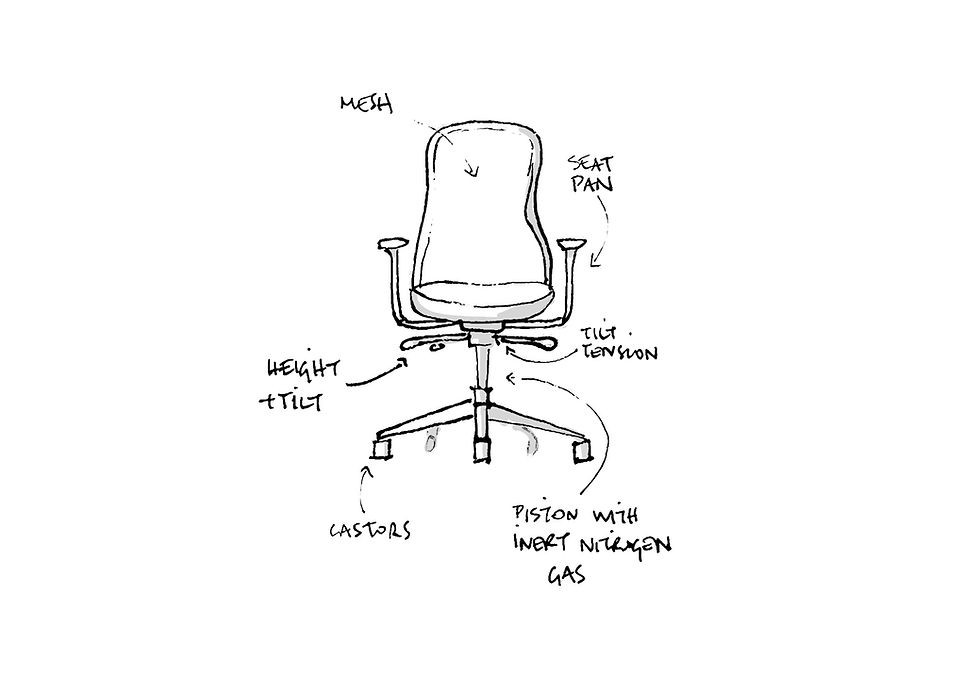
A person sitting in a task chair does not remain centred. They lean forward to type, shift sideways to reach for a document, recline to think. With casters reducing friction, the chair can move beneath them. A four-legged wheeled base would create greater tipping risk when weight shifts diagonally between supports. The five-point star, spaced evenly at 72-degree intervals, distributes load more effectively across a circular footprint. It reduces overturning moments during rotation and recline while maintaining manoeuvrability. In other words, the fifth leg is not decorative excess. It is structural logic. The addition of a central gas lift reinforces this geometry. Height adjustability requires a single vertical column aligned directly beneath the user’s centre of gravity. That column, in turn, demands a radial base to prevent instability. Mechanisms for tilt and tension sit within that central axis, adding depth and mechanical complexity. Every visible component is there to solve a problem relating to movement and duration.
By the time we reach late-20th-century designs such as the Aeron Chair, the five-star base is not optional; it is fundamental. Even more refined designs like the Eames Aluminium Group Chair may soften the visual language through proportion and materiality, but they retain the same essential structural principles.

The difficulty, from an interior perspective, lies in geometry. Most domestic spaces are composed around rectilinear order: walls meet at right angles, floorboards run in parallel lines, cabinetry reinforces linear rhythm. Sofas and dining tables echo this logic. The office chair interrupts it with radial symmetry. Its footprint is circular; its legs splay outward; its casters introduce visual fragmentation at floor level. It behaves less like furniture and more like equipment.
This is why integrating it often feels unresolved. It’s not simply a matter of aesthetics, but of typology. We are attempting to place a piece of kinetic engineering into a composition built around stillness.
It is interesting, for example, that the Eames Lounge Chair and Ottoman integrates so effortlessly into carefully curated interiors. It is generous in scale, undeniably engineered, and yet it reads as sculptural rather than mechanical. The difference lies partly in what it is designed to do. The lounge chair supports rest, not task-based movement. Its base is fixed, its posture reclined but stable, its materials warm: moulded veneer, leather, polished metal. The mechanisms are either concealed or secondary to the silhouette. It participates in the room as an object of permanence.
By contrast, the office chair foregrounds adjustability. Its levers, casters and central column remain visually active, signalling constant potential movement. Where the lounge chair settles into a composition, the task chair feels perpetually prepared for departure, as though it has somewhere more important to be. One is resolved as furniture; the other remains visibly equipment. That distinction, more than style alone, explains why one feels at home, in a mid-century, eclectic or modern interior perhaps, while the other often resists belonging.

Perhaps what unsettles us is not just its appearance, but what it represents: the merging of work and home, the erosion of spatial boundaries, the reality that our bodies now spend much of their day mediated by technology. The office chair is engineered evidence of that condition.
When I look at one now, I see less failure of design and more negotiation between physics and posture, safety and freedom of movement, endurance and efficiency. The five legs are not a stylistic decision; they are the visible outcome of problem-solving under constraint.

That does not automatically make them beautiful. But it does make them honest. And sometimes understanding the logic behind an object is the first step toward integrating it with intention rather than frustration.
I still don’t have an office chair in my flat. That absence is not accidental. It's an ongoing negotiation between posture and atmosphere, between what my body probably needs and what the room is trying to be. Understanding the structural logic behind the five legs hasn’t solved the problem, but it has reframed it. The resistance I feel is no longer aesthetic snobbery; but rather a clash of typologies.
As designers, perhaps the challenge is not to erase these objects, but to design spaces that accommodate their honesty without allowing them to dominate. Some pieces are engineered for movement, others for stillness. The work lies in recognising the difference and composing accordingly.


Comments